The foundation of the psychology as a natural science is dependent only on that how much we recognised by lawfulness (nature legal contexts, natural laws) of the appearances which we assign to the psychology!
With the here introduced natural laws of the psychology, after I had discovered them (befor 1999), the foundation of the psychology as a natural science is subsequently again proved!
Processes (in the nature) are subjected to lawfulness, so-called natural laws or natural lawfulness.
Since the human being is a part of the nature, also his actions are determined by natural laws!
What concerns the "free will" is my opinion that of the professors Dr. Gerhard Roth and Dr. Wolf Singer: There is no "free will". My reasons are, however, due to the natural laws discovered by me, in the particular as also in the fundamental one more clearer and more precise.
In order to understand experience*(please see the explanation at the end of this chapter)and behaviour of the human being, one must know the lawfulness which underlie the (psychological) appearances and work here.
The lawfulness (the nature-legal contexts) which ones determine the experience and behaviour, I describe in the following one detailed and make even more understandable with illustrations.
Table of contents
________________
The
nature-legal basics of the psychology
· The most basic definition of the psychologie
1.
The course of the effect "Human being-environment"
-> Illustration 1
1.1
How does the course of the effects environment-human being arise?
1.1.1
The Environment-Mediating-Organs (Definition)
-> Illustration 2
1.1.2
The Behaviour Organs (Definition)
1.1.3
Environment-Mediating and Behaviour Organs
-> Illustration 3
1.2
The Control Circuit (Closed-Loop Control System) Environment-Human being
1.2.1
"Linking" of the sense organs (Environment Mediating Organs) and Behaviour Organs
- Remark on the selection
1.3
THEOREM of the DIETMAR G. WEST to the BEHAVING
2.
The Control Circuit Environment-Human being
· THE B A S I C L A W OF THE P S Y C H O L O G Y
· The comparison of required value and actual value and the commands onto the Behaviour Organs.
-> Illustration 4
· NATURE-LEGAL PROCESSES within (below) of the BASIC LAW OF THE PSYCHOLOGY
· Highlighting of controlled variables in the BASIC LAW OF THE PSYCHOLOGY
-> Illustration 5
- Examples to the controlled variables (the controlled sizes)
2.1
Comparing
2.1.1
The brain, the experience (Erfahrung) and the required value
· The experience and the "Knowledge" from the biological (organic) development (evolution)
2.2
Behaviour (performed through the behaviour organs)
2.3
Comparing and behaving - at all living beings
2.3.1
The balanced state (the balance)
2.3.2
The control action (definitions)
2.3.3
Experience (in the sense of "Erleben") and behaviour
-> Illustration 6
2.4
The control circuit and the control action at examples
2.5
How does the brain to the new one stand?
PSYCHOLOGY - their NATURAL LAWS
- Continuation
3.
The mutual control
-> Illustration 7
3.1
The mutual control via a (passive) object
-> illustration 8
·
The most significant result of this discovery
_____________
The psychology becomes today "... as science of the human experience, behaviour and action..." described. Psychology, page 9, summons from the dictionary from Werner D. Fröhlich, dtv 2000).
"Psychology is the science of the experience and behaviour of the human being." summons from the "Paperback of the psychology", page 15, from Heinz Hemling, Humboldt paperback publishing house, 1974).
Interactions: What these both gentlemen with
that to the expression bring, follows from the effects of the
environment on the human being and the effects of the human being on the
environment. One can speak of interactions or call her such. Therefore
it is to consider the nature-legal context between human being and
environment more precisely in order to be able to determine the experience and behaviour more precisely therefore. The most basic definition of the psychology results anyway from the Basic Law of the psychology as I derive it then here.
The psychology is the science of the interactions
between the environment and the human being.
This defintion contains then also the experience and the behaviour. In this case the experience is to be understood here, that results from the effect of the environment and the behaviour with which the human being works into the environment.
In the following one describes and I show contexts as they are by nature law given. There are thus natural laws.
---
is the course of the effects between environment and human being and also between human being and environment.
One of the very basic conditions, that is, one of the nature-legal basics for the understanding of psychological processes, is the knowledge of the effect course of the events between a human being and his environment.
I only also name this course of effect shortly: Course of Effect Environment-Human being or Course of Effect Human being-Environment. In the future I prefer to speak of the Environment-Human being-Course of Effect, or shorter of the Effect Course Environment-Human being.
For the further considerations and descriptions of the course of effect I take graphic representations for the help in which ever a box represents the environment (to the left in front of you) and a human being (to the right in front of you). Environment and human being are "combined" by two arches in this figure. The arrows show the direction of the effects.
Illustration 1 showsThe Effect Course Environ-ment-Human being: It is a closed course of effects. It corresponds to a control circuit (a closed-loop circuit.) I will handle the control circuit later.
I repeat this course of effect again:
Environment --> stimulus processes --> processing in the brain --> behaviour --> environment.
---
Such a course of the effects results once from the fact, that a human being the environment by means of certain sense organs (I named it in my scientific treatises --> Environment-Mediating-Organs) provided gets.
Sense organs have receptors in which at first once stimulus processes take place from which corresponding announcements (Signals, impulses) follow and are led in nerve lines onto the brain.
---
"Environment-Mediating-Organs" is one of several concepts [terms] which were introduced by me new. In this way organs are meant, through which a human being gets environment and the changes occurring there provided. One speaks at these organs also of senses (seeing-sense, hearing-sense, and so forth).
Such sense organs that provide us the environment e.g. the eye, the ear, also the nose and the mouth as odour and taste sense are however. Also still the tactile sense is to be belonged to that, therefore all organs "or senses" that mediate the human being the environment.
Perception
I write with intention, that the sense organs "mediate environment" and not of the "perceive through the sense organs" because the perception arises only if the one provided from the environment through the sense organs was processed by the brain correspondingly.
Only after that results the perception (and e.g. for the illustration of the environment in the brain, for the experience and for all the appearances which we assign to the psychology which you hear about later more).
The preceding illustration shows therefore the Course of Effect Environment-Human being (human being-environment): it is a closed course of effects. In detail it can be described in coarse steps as follows:
Environment --> the environment and their changes reach the receptors of the sense organs as "physical and/or chemical events (events "happenings")" and cause stimulus processes; the event in the receptors (changes there) become --> onto the brain in which a processing occurs; this processing has the objective purpose --> to cause a behaviour, with which the human being --> into the environment works.
In this way the course of the effect closes!
I repeat this closed course of course of the effects again through the emphasised concepts:
Environment --> stimulus processes --> processing in the brain --> behaviour --> environment.
In this way the course of the effects is closed!
Details in the course of effects:
In the following representations of more details in the course of effect I keep on using two boxes, one for the environment (to the left in front of you) and one for the human being (to the right in front of you).
However I do not do the connections of these two boxes anymore through arches, but I do it through straight lines, as the following illustration shows.
This representation is very useful since it allows a simple and clear representation of the course of effect and the details. More boxes can be fit little by little and to be complemented the single boxes with details.
Illustration 2
You see in turn the course of the effect which I declare through the single areas again:
Environment --> stimulus processes --> processing in the brain --> behaviour organs --> behaviour --> environment.
Also here the course of effect closes!
---
"Behaviour organs" is one of several terms and concepts which were introduced by me. In this way organs are meant, through which a human being carries out his behaviour and with which it works into the environment. There are e.g. the arms, the hands, his legs and feets (therefore the movement apparatus), however also his mouth and what appertains to in order giving sounds or speaking sounds.
Also through sounds or speaking a human being (or a living being) works into the environment.
---
I derived these terms - Environment-Mediatong-Organs and Behaviour Organs - from the task and the purpose which they fulfil in the strategy (plan) of the nature for the live thing. That means that with the calling of these terms (denominations) it is to be understood easily what is meant. Through that these terms (denominations) become concepts which I represent in the following illustration again in context.
Illustration 3: Effect cours of the events
Task: Attempt to find out or to determine how many of such courses of effects for instance go through your brain on a day.
---
If a human being works through his behaviour into the environment, also something is changed then there. In turn the brain is provided through the sense organs(Environment-Mediatong-Organs) with these changes in the environment (see stimulus processes).
The brain in turn uses the "new situation" in the environment and in turn a corresponding behaviour arranges. A feedback occurs on this manner and we have to do it with a control circuit (a closed-loop control system).
I describe this control circuit nearer a little later as the Basic Law of the Psychology.
---
The sense organs (here the Environmental-Meditating-Organs) and the organs carrying out the behaviour - the Behaviour Organs - are "tied together" in this control circuit (closed-loop control system). Through that it is expressed that these must be agreed on with each other in certain manner!
Example: If a human being (or other living being) has behaviour organs through which it can reach great mobility and speed, that has only a purpose then although the fast changes which in this case arise can provide the sense organs (environmental-meditating-organs) to the brain.
Example: If a man or a human being has sense organs that mediate the environment and the changes in the environment which it can not react to, that does not have also any purpose.
Task: Attempt at different examples to describe what would happen if that was not like this as I state it in the examples!?
Remark on the selection:
The tuning of the sense organs (or sense cells, or receptors) with the Behaviour Organs might have played a significant role in the evolution and with a selection factor have been!
---
Behaviour shows every living being. Behaviour developed itself in millions (even billions) of years with the living beings. The behaviour is characteristic of the species, but individual also with restricted deviations.
The behaviour has a purpose which is identical with all organisms.
About the purpose of the behaviour I would like for all living beings (and also for the human being) to state following that is to be understood as a theorem:
The purpose of the behaviour of every living being and so also
the purpose ofthe behaviour of the human being is,
the maximum safety for his life and survival to reach.
One can say it also so:
Through the behaviour a living being, that is also a human being, for the environment (the factors, the conditions) is supposed to make a relationship that offers him maximum safety. (see also adaptation --> relationship, and so forth.)
Task: Doubts above that whether this theorem is right could arise with you in particular when you refer it on the human being. If that is the case, you attempt to gather the reasons for your doubts and formulate them.
Attempt to fathom then what you not taken into consideration and why this theorem is nevertheless correct!?
---
· THE B A S I C L A W OF THE P S Y C H O L O G Y
I have represented and described the Closed Effect Process Environment-Human being (control system)in the previous one. I am passing to describe this effect process by more details now.
The Closed Effect Course is to be considered as a control, mentioned as already, (since he is a control circuit, a closed-loop control system).
What I did not express up to now yet and what for a control circuit belongs (--> control operation), a functional area in which a comparison occurs is. It is a so-calledrequired value-actual value comparison. This functional area is assigned to the controller. The task of the controller takes over the brain.
Required value-actual value-comparison and the Behaviour Organs:
The required value-actual value-comparison has the purpose to form a difference (a signal) that is a command for the organs following in the course of effect. This command is a basic quantity which actuates the following organs. It is named as manipulated variable.Such a manipulated variable is e.g. the frequency of the impulses in the motor nerves which lead to the muscles.
Remark:
The hormones are another kind of manipulated variable, which reach cells by means of the blood purposeful and so into the activity (behaviour) of the organs and in this way the organism's intervene.
I will include these manipulated variable (a basic quantity) in the consideration of the control circuits later.
With the human being the organs receive in the Environment-Human Control Circuitcommands which would drive the behaviour. I call these organs Behaviour Organstherefore.
The representation following now contains already sufficiently fundamental one and the necessary details in order to be able to speak of the Basic Law of the Psychology. I will explain this testimony constantly. At first once the graphic representation:
Illustration 4:The Basic Law of the Psychology. It is the Basic Law of the Psychology because all appearances which we assign to the psychology follow from this Environment-Human being Control Circuit (closed-loop control system).
In this illustration 4 you see to the right about in the middle, the black line with arrow, besides that "Set value,(required value) and Reference variable" stands. This black line with arrow does not show any further connection and you find here no further specifications about it. But you find already now in the chapter THE PRINCIPLE OF ALL LIFE some more on this complex topic of the Set value,required values and the Reference variable, which I will deal with later.
You see the environment to the left again and to the right a human being. The thicker black lines and boxes represent the course of the effects, the effect course. So that you can pursue it more easily and it becomes slowly more known to you, I declare a consequence of the used concepts, that after each other in this - here clockwise rotate recorded - effect course perform:
Environment(controlled variables) --> events-so (actual value-so) --> sense organs --> actual value-p --> actual value --> controller = brain, it compares (represented through the circle) the actual value with the required value (set value) and one forms a coresponding valuefor the --> manipulated variable (a basic quantity)--> actuator (final control elements = behaviour organs --> behaviour --> environment (controlled variables).
In this way the effect course is closed also here!
As a matter of course are not here yet captured all details, in particular the steps of the processing in the brain. Many boxes with contents would have to be fit therefore still. I only fit the boxes described with "A" and "B", around no misunderstandings arise let over in the brain in detail still processes of the processing ending before it for the comparing and then results e.g. in the commands in the nerves.
Remark: At first once I have, however, also reasons not to serve anymore! (You would understand that if you had become acquainted the ignorance and arrogance of the professors). Now further for theBasic Law of the Psychology.
All which we assign to the psychology follows from this Environment-Human being Control Circuit:
the relationships to other people and to the environment general, whether these are now good, bad, sorrowful, pleasure-full or painful, trusting, cold, cordial, and so forth and whether we designate it as sympathy or aversion, and so forth.
Joy, peace, fear, grief, envy, sorrow, hate, pain, and so forth.
Opinions, Views, ideas, and so forth.
Properties the we e.g. as intelligent, ambitious, kind, "of weak character", "stupid", and so forth designate.
No human being can escape from this nature-legal course - this naturallawfulness of the Environment-Human being Control Circuit. It always works and with every human being and it is therefore a natural law, and indeed:
THE BASIC LAW OF THE PSYCHOLOGY !
Within this fundamental lawfulness of the Environment-Human being Control Circuit that is the BASIC LAW of THE PSYCHOLOGY further processes occur, which certain lawfulness follows and that than as single laws can be described.
These processes, that within (below) this fundamental lawfulness of the Environment-Human being Control Circuitoccur, causes appearances as we know it particularly from the psychology.
Such appearances are for example:
the "feelings" (a definition on nature-legal basis is missing still), which ever: Hate, envy, shame.... and so forth. In particular the purpose and the necessity of the feelings only from this effect course can basically be explained.
the typology(psychological functions and psychological types) according to Carl Gustav Jung
the thinking
the displacement and the veiling (Concepts in the psychology that goes back to Sigmund Freud
the "internal clock" and their origin with the human being and with living beings (see for this purpose also The PRINCIPLE of all LIFE). Also it declares itself only from this effect course.
Conscious one, unconscious
and so forth.
All these appearances are the consequence of lawfulness, that within (below) the BASIC LAW of THE PSYCHOLOGY (the environment-human being control circuit (closed-loop control system)) take place and work.
I will present several of this lawfulness to you little by little.
Task: You are e.g. a studying of the psychology. Then ask your university lecturer or professor what the nature-legal background (the nature-legal basis) of the displacement (see Sigmund Freud) is. If your professor thinks that he knows it, then you let it explain itself and attempt to check by means of what you could learn in this chapter till now. If the professor doesn't know it, then you try to explain it to him using what you could learn here till now. So that it is not too difficult for you, I give you some help:
1. In the BASIC LAW of the PSYCHOLOGY (Illustration 4 and 5) a so-called required value appears. It is corresponding with a demand of a human being from the environment. 2. A mother or a father is for example the environment (left side in the illustration). A child is for example the human being (right side in the illustration).
If the environment, that is father or mother, of a demand of the child does not correspond, than this means, that the actual value does not correspond to the required value demanded by the child.
What means this then for the child? Which possibilities turn out for the child, to become ready with the situation?
---
In the illustration 5 following now I represent the Basic Law of the Psychology again. Unlike the preceding illustration 4 I emphasise the controlled variables(controlled sizes) here and show some of them.
Very clear is here represented, that the controlled variables (controlled sizes) that a human being controls (actively) for himself are taken back and are available to the organism. I show that, when I the lines represented in green with arrows, on the organism focuses.
Illustration 5:The Basic Law of the Psychology. This representation contains more details to the controlled variables (controlledsizes).
This form of the representation has the advantage, that I or you can add further controlled variables (controlled sizes) to this control circuit(the Basic Law of the Psychology) and that simply, when one draws in more such lines with arrows, that are focused on the organism and enters the corresponding name of the controlled variable (the controlled size).
Task: Indicate more controlled variables.
Before my performing further controlled sizes in another illustration, I would like to describe first of all a little more precisely the sizes (the controlled variables) indicated in the illustration 5.
Oxygen-concentration in the air The human organism arose in some surroundings in which in the air a certain percentage of oxygen is contained. This percentage at oxygen can disappear possibly. That can be, if many people are for example in a room and is provided oxygen not sufficing. If one climbs into the height, the oxygen breathed in is changed because of the smaller air pressure. The necessary oxygen or oxygen concentration can be restored by corresponding measures (behaviour). That happens e.g. today during the mountaineering when oxygen is taken along and provided above breathing apparatus. In another case windows are opened or one mandatory ventilation introduced. All these are measures (behaviour) which result in holding the oxygen or the oxygen content in the air on a certain needed value. With other words: A certain behaviour is necessary to achiev the required value of the controlled size - here the oxygen. These measures (behaviour) can be different and require a comparison and a corresponding behaviour, by which the oxygen or the oxygen concentration is controlled (regulated) in the air which is breathed in. (See also --> THE PRINCIPLE OF ALL LIFE (GB) ).
Intensity of the light We only see objects of our environment if a certain light intensity hits the objects. So that we surely move in the environment, it is therefore important that light hits the objects sufficiently. This way we avoid that we for example stumble or to hit us the head. Only if sufficient light falls on an object, we can recognize or grip it for certain. With light intensity the light is meant here therefore, that hits objects that is supposed to provide us our sense organ eye. We try therefore to put important objects in a light, that is sufficient that an object is provided to us. So we move on ways which are sufficiently illuminated. Or we illuminate the way we must go. In this way we avoid dangers, what then contributes to more security. The examples shows how we control (regulate) the light intensity on the objects by comparison and in the end by a corresponding behaviour.
Temperature The temperature is a property (a quality) of our environment and in this way a physical size. The human organism needs a certain ambient temperature to live. Therefore this size (this property of the environment) becomes a controlled size which must be controlled by the behaviour of the human being. In this case the temperature is at the body, therefore at the skin ultimately decisive. If the temperature is at the body in a certain range, the organism can take over the rest of regulation and hold the temperature in the interior (about the 37 degrees).
The human being has different possibilities to keep the temperature arround the body in a certain range. The human being can move in the shadows or from the shadow; he can put on or take off clothes; he can go into a room and heat it or cool it off. So man can regulate (control) the temperature surrounding his organism.
Performances What concerns these controlled sizes, they exist in many forms. Performances are accomplished daily in the household, in the work, in the sports or in school. If they bring us advantages or give subjectively the impression of advantage, e.g. we try to achieve high values as in the case of the performance in school what means good marks in the end.
Distances A human being must keep for different reasons distances to the different objects in his environment. Not to bump once around himself at objects. In quarrels one will attempt as inferior one to hold distance to a stronger one. In addition one needs distances which arise from territorial claims which are used e.g. for the food procurement, and so forth. We regulate these distances by comparison and in the end by a corresponding behaviour in the environment-human being closed circuit.
Why does that appertain to the psychology?
Maybe now you will say: What is supposed to be at these controlled variables (light intensity, oxygen content, performances, temperature, distances) psychological? Why is one supposed to speak of psychology here? Now, you will soon inspect that if does not succeed in holding these controlled variables within a certain range of values or on the values that the organism needs in order to function.
1. Oxygen-concentration in the air If you are in a room with many people and there is oxygen deficiency in the room because it is not sufficient ventilated, you become restless, you become nervous, or even aggressive. You "are fed up with it" and you can get even feelings of oppressiveness and fear. If you are hindered to change the state, you begin quarrel with the people who hinder you at that, and so forth. 2. Intensity of light Similarly you do if you do not have light sufficiently in order to carry out a work. You become restless, you become nervous, or even aggressive. You make errors (mistakes) and become furious. If you are hindered to change the state, you begin quarrel with the people who hinder you at that, and so forth.
3. Temepratur If the temperature is not suitable for you, you become restless. You do not feel well, you become impatient and you would like to change the state quickly. You swear about the state or you tear a garment of the body, if it is too hot.
4. Performances You are surely not averse to serve with performances. But if for example too much performance is demanded, one will be then overtaxed and "will not feel" well anymore. Depending on whether it can lead to depression if one can not follow certain performance demands.
5. Distances You feel uneasy if you can not keep to distances. You feel uneasy if somebody too near moves onto the body. Differently in turn you complain in some cases if distances are too great and so forth.
You see therefore, that we have to do it here with the basics of the psychology and indeed not with any blethered or thought basics, but with the nature laws given that result from the demands of the life and the survival.
---
Dear visitor,
I am sorry that I can offer you this translation only to here in English at the moment. I will do my best to make the translation up.
I have a request to you now: Since my native language is not the English language, will presumably be faults in the text. I would be very grateful if you would draw my attention to faults.
You find my address at the end of the chapter: LECTURES, lessons and contact.
I will complement this home page step by step and present the promised natural lawfulness and natural laws to you.
Please still have a look at these and the other pages therefore at a later visit. At first once Many Thanks for your interest!
---
Very important:
* The English language does not plan unfortunately any own word for the process which is described in the German with "Erleben" !
In the English as also in the French vocabulary there is unfortunately for two different and strictly to be distinguished processes, wich in the German are named with "Erleben" and "Erfahrung" only a word (a concept), namely "experience" respectively "expérience" (in French).
Released: 04/2008; English: 04/2010 01.06.2013: Description of the examples of the controlled sizes in the representation5 30.03 2015: · The most basic definition of the psychologie added














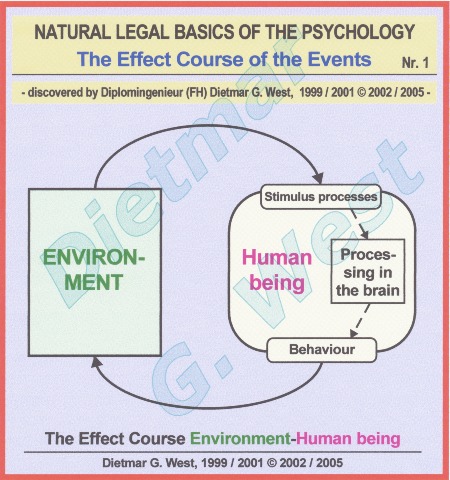 Illustration 1 shows The Effect Course Environ-ment-Human being: It is a closed course of effects. It corresponds to a control circuit (a closed-loop circuit.) I will handle the control circuit later.

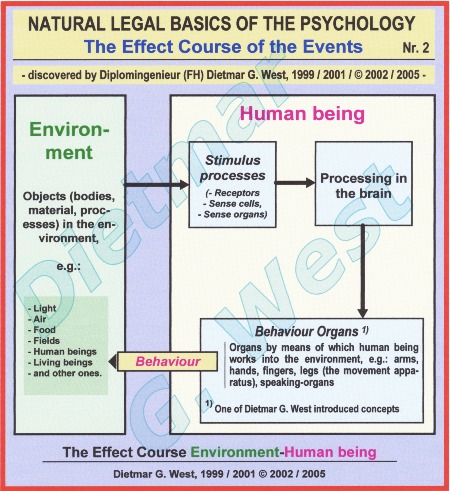 Illustration 2

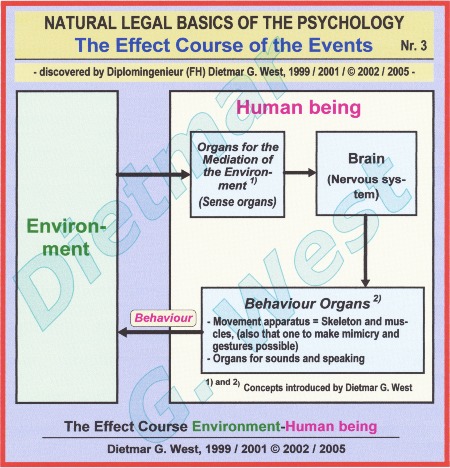 Illustration 3: Effect cours of the events




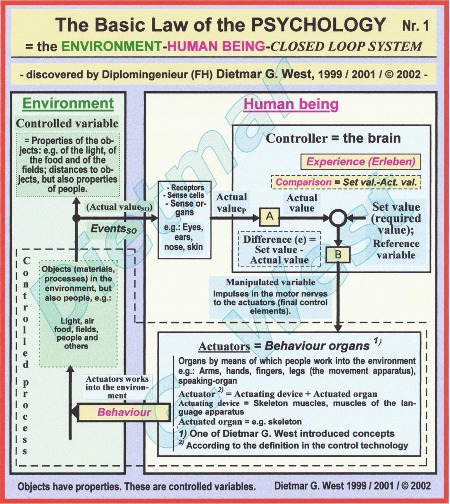 Illustration 4: The Basic Law of the Psychology. It is the Basic Law of the Psychology because all appearances which we assign to the psychology follow from this Environment-Human being Control Circuit (closed-loop control system).

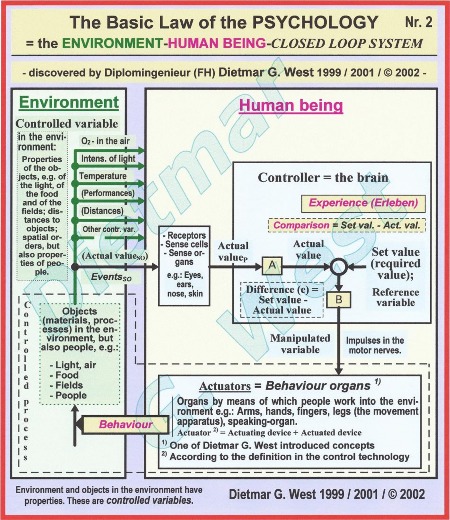 Illustration 5:The Basic Law of the Psychology. This representation contains more details to the controlled variables (controlledsizes).